Published August 13, 20263 min
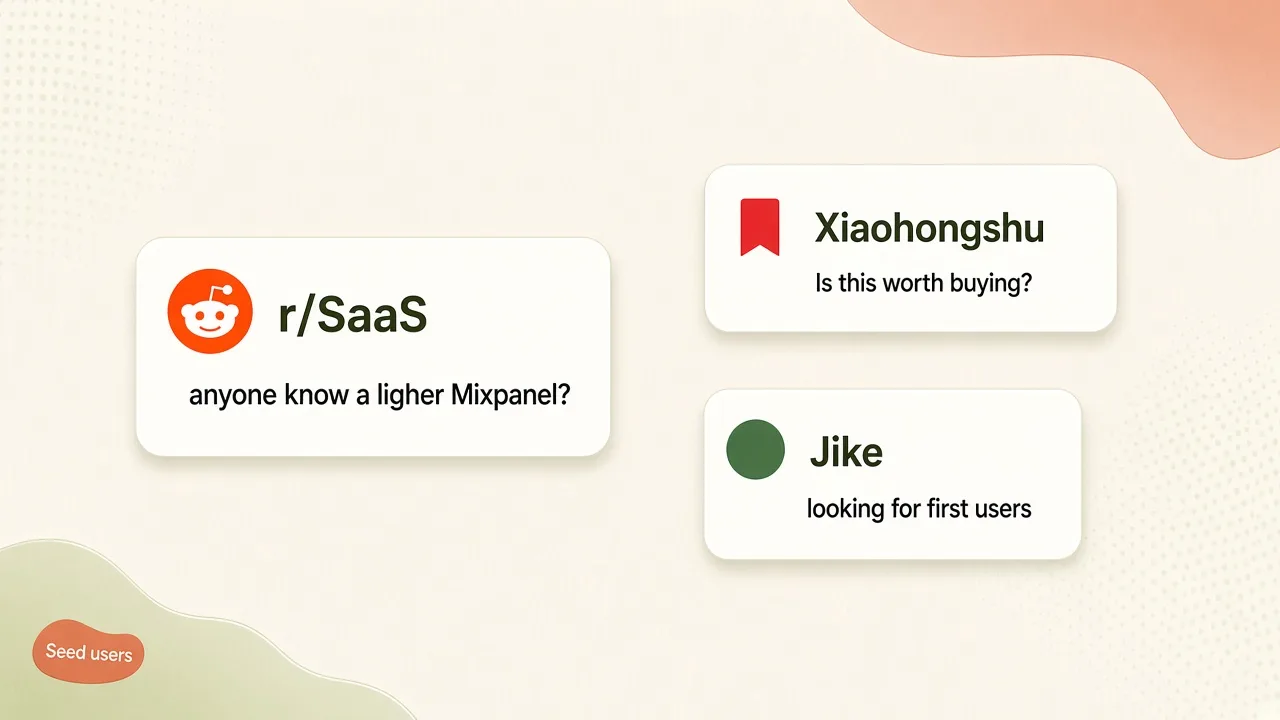
The good news: your target users ask in public every day. "Is there a tool that...", "what do you all use for...", "any recommendations for..." — those posts are a live, self-updating list of seed users. This guide covers where to look, which posts deserve a reply, and how to reply without being annoying.
Xiaohongshu: the comments are worth more than the posts
Most teams only ever publish their own notes on Xiaohongshu. For finding seed users, search and comment sections are the real arena — that is where specific people describe specific struggles.
Search scenario + pain phrasing, not category names
Users describe problems in their own words, not in your category's vocabulary. Search what they would actually type — for example, Chinese phrasings that translate to:
"indie dev + cold start""how to find first users""looking for tool recommendations"Mine the comments under popular posts
Under a note about "how to find seed users", the commenter asking "is there a more concrete method?" is closer to your customer than the author is — commenters arrive with intent.
Triage before replying
Specific scenario beats vague question; posted this week beats last month; someone who follows up beats someone who only likes.
The rule for replying: answer the question well first, with advice that works even without your product. Mention the product in the last line, or wait to be asked. A useful answer is the acquisition.
Reddit: a higher bar for useful, but closer to a purchase
Pick subreddits where users complain, not where founders promote
Beyond r/SideProject and r/indiehackers, the valuable subs are the vertical ones for your niche — where people describe problems instead of pitching each other.
Run fixed search phrases, sorted by New, daily
Combine each phrase with your domain keywords and scan once a day. Timing matters: replies within hours of posting get accepted far more often than replies three days later.
"looking for a tool""any alternative to""is there a tool that""how do you guys handle"Answer first, disclose always
Write the genuinely useful answer, then one line: "I build X, we work on exactly this." Reddit has near-zero tolerance for undisclosed promotion — a mod ban costs more than any single thread is worth.
Reddit threads rank on Google for years, so one thoughtful reply keeps sending qualified visitors long after the thread goes quiet.
The three bottlenecks of doing this by hand
- Time: 20 focused minutes per channel per day is an hour across three channels — and it only works if it happens every day.
- Timing: the best posts appear while you are offline. By the time you see them, someone else has answered.
- Knowledge: your triage criteria live in your head. They can't be handed to a teammate, and they reset when the team changes.
Turn it into a 15-minute daily routine
OpenNomos turns the manual loop into a system: you define the rules once (audience, topics, channels, red lines), and agents scan daily, delivering matched posts with the reason each one matched.
The important part: OpenNomos does not auto-reply or mass-DM. You decide whether and how to respond to every opportunity — finding can be automated, talking has to stay human. Your feedback makes the next day's list sharper.
FAQ
How many seed users are "enough"?
For most products, a few dozen early users you actually talk to are worth more than thousands of sign-ups that churn. Optimize for depth of conversation first.
Should I run paid ads during the cold start?
Until you can reliably convert people who are already asking, ads only amplify an unvalidated funnel. Validate the pitch on free channels first.