Published August 14, 20263 min
What it looks like in practice
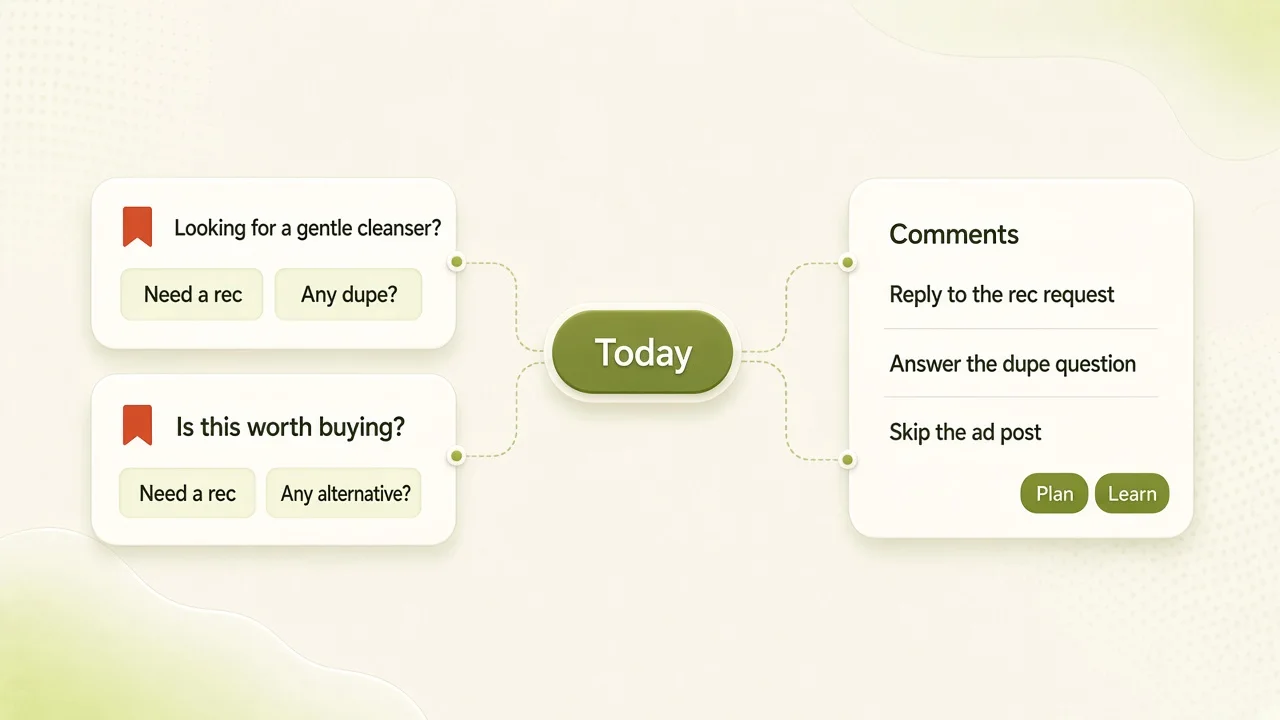
You set rules in your product language: who the buyer is, scenario + pain phrasing (not category jargon), and what to ignore. Agents scan Xiaohongshu daily for question notes and high-intent comments, then deliver a short list with context, match reason, and a reply angle. You keep a few for this afternoon, write the human answer, and mark the rest keep or drop.
Comments > broadcast posts
Rules prioritize askers in comment sections and "求推荐" notes — people who already raised their hand.
Scenario + pain phrasing
Search what users type ("通勤党求推荐…"), not your internal category name.
A list the team can finish today
Enough summary to decide, even if you do not live in Chinese. Keep two comments for this afternoon. You still write the reply.
What the opportunity list looks like
Same Studio opportunity UI — sample Xiaohongshu rows for a consumer routine product.
Xiaohongshu
有没有更省事的方案?现在这套太折腾了
Reply with a concrete tip that works without buying; soft mention only if natural.
Xiaohongshu
通勤党求推荐:有没有更好用的平替?
Answer the question in-comment first; product in the last line or after follow-up.
Xiaohongshu
踩坑了,还有没有别的办法?
Help in the thread now; capture the recurring ask for content ops.
Rules a consumer team typically sets
- Target user: e.g. office workers seeking a specific lifestyle or efficiency fix; parents; beauty / fitness buyers — whatever your ICP is.
- Pain phrasing: "求推荐", "有没有更好用的", "踩坑", "平替", scenario words + product job.
- Where to look: question notes and comment threads under category-adjacent viral posts.
- Skip: pure unboxing flex posts, giveaway spam, off-city or off-budget asks you can't serve.
What one morning looks like
Open Xiaohongshu-sourced opportunities
Usually a mix of Potential User (someone asking for a rec) and Content Opportunity (the same pain asked repeatedly).
Read the match reason
Example: "Comment under a 'commute skincare' note asks for a simpler routine for oily skin — matches ICP + scenario + unmet ask."
Use the suggested action
Answer the question helpfully in-comment first; soft mention only if natural. Hard sell in Xiaohongshu comments backfires fast.
Keep or drop
Keep the comments worth a human answer this afternoon. Drop soft leads and wrong demographics so tomorrow weights real purchase-intent asks higher.
A concrete opportunity card
Title / snippet: "有没有更省事的方案?现在这套太折腾了" under a popular how-to note.
Type: Potential User Opportunity · Source: Xiaohongshu · Comment · Posted today
Match reason: explicit ask for a simpler alternative; scenario matches your ICP; author engaged in follow-ups.
Suggested action: reply with a concrete routine tip that works without buying anything; mention product only in the last line or after they ask.
Team time: 5–10 minutes per high-quality reply — often higher conversion than a polished brand note nobody asked for.
FAQ
Our team doesn't read Chinese fluently — can we still use this?
Yes. Opportunities arrive with enough context and match reason to decide; you can brief a Chinese-speaking teammate or partner to write the final reply.
Is this only for China-based brands?
No. Cross-border brands with Chinese-speaking buyers use the same workflow — Xiaohongshu is often uncontested by English-first competitors.